
Post-Frame Buildings – Footing Size Calculation Guide
Determining the Footing Size Needed for Post-Frame Buildings
Isolated footings describe a foundation type that supports a post or column that is not part of a continuous footing. The footing is “isolated”, and therefore it is straight-forward to calculate the load capacity of this footing type because there is no shared weight. All the weight carried by one post is transferred to one footing. Regardless from what material an isolated footing is made, it functions by spreading the load carried by the post over a larger surface area. As long as the footing for the post-frame building is stronger than the soil on which it sits, the larger the surface area of footing, the larger the load it will carry. If stronger than the soil AND overloaded, a footing will simply sink into the ground.
By knowing two things:
1) Weight on the footing
2) Load capacity of the soil
You can determine the footing size needed to support the load by using this formula: A = B/C
A = Surface area of the footing
B = Load on the footing in pounds
C = Load carrying capacity of the soil in pounds per square foot (psf) Please Note: Because each post is sitting on an individual footing, we use “post” and “footing” interchangeably throughout this guide.
FootingPad post foundations are round, and the surface area of any circle is determined by the formula: pi r2 = 3.14 x (radius x radius) The surface area of a square or rectangle is determined by length x width. For example, a 12” x 12” square has a surface area of 1 sq. foot.
Load Calculation Formula Applied to Post-Frame Construction
Calculating the size needed for the footing of a post-frame building can be easily determined because of the simple load bearing structure. Typical post-frame building construction involves a series of posts opposite each other with a truss or rafters spanning the distance. The ultimate load is the defined by area of the roof carried by each post.
The farther apart the posts are spaced, both in building width and side wall post spacing, the more load on each post. As typical post-frame construction will have sidewall posts spaced equally, each post carries approximately the same weight. There is little weight on the end walls, so to calculate the load on the footing, the only data points needed are the building width and post spacing. The FootingPad calculator pre-fills the dead weight load of a common steel-roofed at 5 lbs. per square foot.
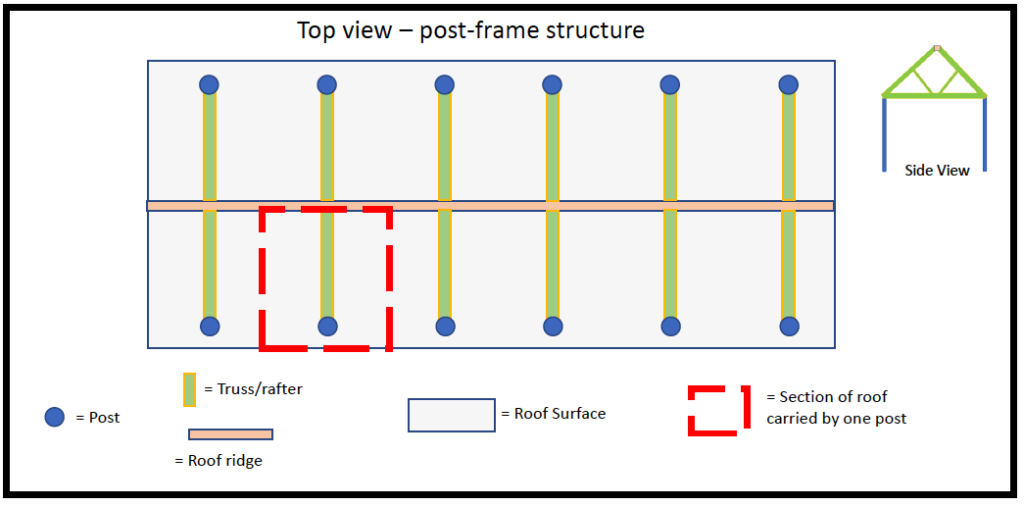
Example – Post-Frame Footing Calculation
If the following data is entered into the FootingPad calculator, the footing size recommended is a 16” diameter FootingPad. Here’s how we get there:
Building Width: 40 feet
Soil Capacity: 3000 psf
Post Spacing: 8 feet
Snow Load: 20 lbs. / square foot
Surface area of footing (in sq. ft) = Total load (in lbs.) on footing / Soil Capacity (lbs/sq ft)
Total load = (½ building width x Post spacing) x (5 lbs. dead load + snow load)
= 20’ x 8’ x (5 + 20 lbs. / square foot)
= 160 square feet x 25 lbs. / square foot
= 4000 lbs.
Surface area of footing (in sq. ft) = 4000 / 3000 Surface area of footing (in sq. ft) = 1.33
In this example, the necessary surface area of the footing calculates to 1.33 square feet. More accurately, this formal describes the MINIMUM surface area of the footing. A larger footing will work, but also means digging a larger hole. Using the chart below, any footing larger than 1.33 square feet will work. The 16” FootingPad will be recommended by our calculator using the data supplied in this example:
Load Calculation Formula for Post Frame Door on SIDE Wall
Many post frame buildings have overhead or other large doors on the end walls, which carry little structural weight. If your post frame building has a door on the SIDE wall, and that door is WIDER than your post spacing, you will have extra weight on the posts on either side of the door. This will require a separate footing size calculation.
| FootingPad Diameter | Surface Area of Footing (sq.ft) |
|---|---|
| 10" | .545 |
| 12" | .785 |
| 16" | 1.39 |
| 20" | 2.18 |
| 24" | 3.14 |

Because of the wider spacing of the posts on either side of the wide garage door, there is more roof carried by those posts which increases the load. Therefore the calculation changes slightly.
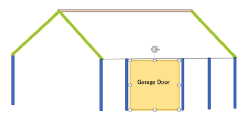
Using the same data from the earlier post frame example:
Building Width: 40 feet
Soil Capacity: 3000 psf
Post Spacing: 8 feet
Snow Load: 20 lbs. / square foot
Surface area of footing (in sq. ft) = Total load (in lbs.) on footing / Soil Capacity
Total load = (½ building width x (½ Y + ½ Y1 Post spacing) x (5 lbs. dead load + snow load)
= 20’ x (1/2 of 8’ + ½ of 16’) x (5 + 20 lbs. / square foot) FootingPad = 20’ x (4’ + 8’) = 240 square feet x 25 lbs. / square foot diameter = 6000 lbs.
Surface area of footing (in sq. ft) = 6000 / 3000
Surface area of footing (in sq. ft) = 2.0 As the 20” FootingPad is larger than the required 2.0 square feet, this size is needed for those posts on either side of the door.

Top view – one side